

Consider the Femcel
Inside the outsized self-loathing of the incel’s twin flame.

I’ve been getting really into hating women lately. It seems to be where the zeitgeist is headed, and I think we can all see why. In their grotesque bodies and frivolous femininity, these dumb foids are extremely hateable. I think we can all agree that we hate women and that the worst thing in the world is to be one.
Recently, a spate of women writers and filmmakers have found success making works about how much it fucking sucks to be a woman and how much they hate themselves. But because I loathe women so much, instead of the historically feminine mode of internalizing everything, I’ve decided to turn my animosity outward and hate like a man. If Candace Owens can make white supremacy work for her, why can’t I make misogyny work for me?
What a relief to openly hate women in a public setting! To be able to do away with the masquerade of equality or liberation. It all began when I became infatuated with the ideology of the femcel. Ugly stepsister to the girlboss, the incel’s bride of Frankenstein, the femcel is hyperaware of all the ways she is wrong, wrong, wrong. And how right she is.
Femcel and incel culture is rooted in the same core belief, which is, naturally, a hatred of women (love). For the men in incel communities, this hatred is aggrandizing. It raises him up out of his economic, social, personal, etc. abjection and gives him a superior perch from which to see the world, himself and the comrades he’s found through their shared worldview. For the femcel, however, hating women can only lead to back to abjection. It might disgust you that there are men who want to own women like we’re a piece of property. But we also can’t move forward without acknowledging that there are women who just want to be owned.
If you had to place this figure in the current culture, she’s caught in the crosshairs of Red Scare, Dimes Square, literary e-girls, Ivy Wolk, the return of heroine chic and heterofatalism.
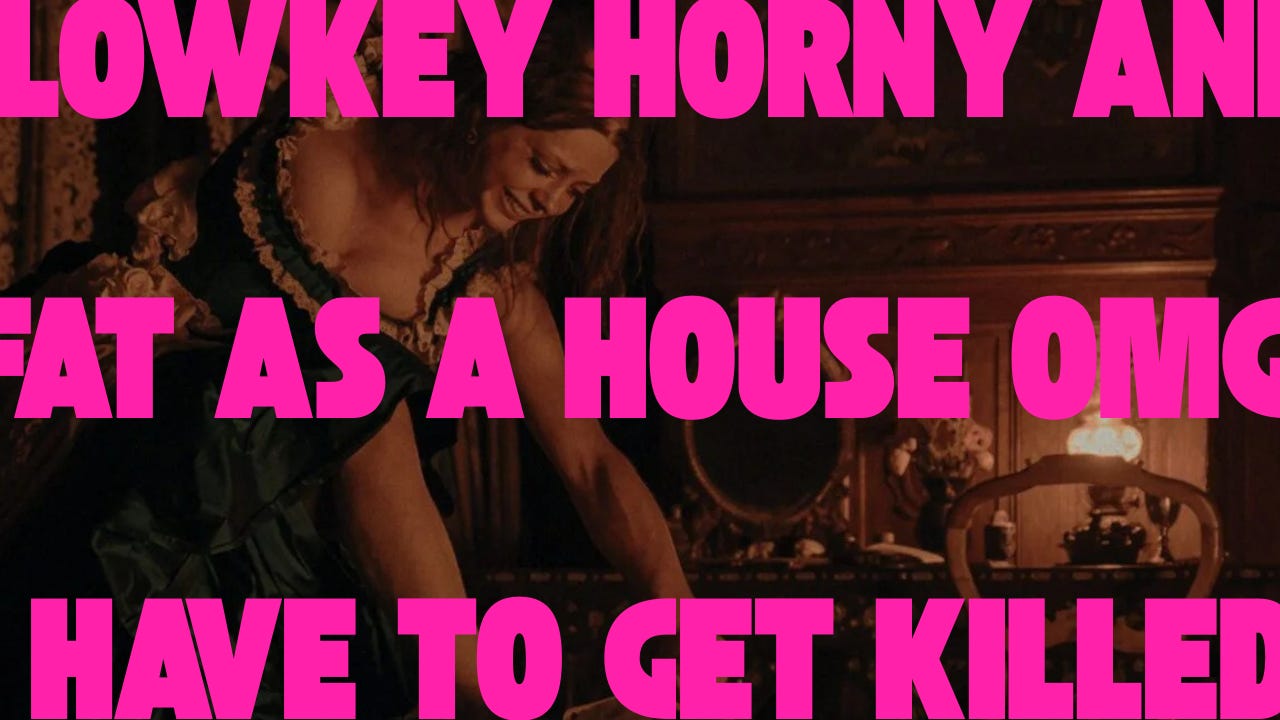
Wolk, internet nuisance and femcel philosopher, coined the now-famous online saying (also known as a tweet), “lowkey horny and fat as a house OMG I have to get killed.”
Break that down and you can see a femcel manifesto being born. Horniness and fatness are integral to her identity but are also in direct opposition, canceling each other out in death. She’s self-hating but self-aware enough to think that makes it okay. The lack of active voice renders her so lethargic that even her suicidal ideation is passive. That’s the central idea of anorexia, to simply do nothing unto death. And it’s become the femcel’s main mode of interacting with the culture. Who wants liberation when you can have an eating disorder?
I’ve seen anorexia destroy the most mediocre minds of my generation. Since the days of Ottessa Moshfegh’s My Year of Rest and Relaxation, the femcel has been somnambulantly creeping into the literary world, creating “anorexic writing,” which doesn’t necessarily feature characters with eating disorders but rather a type of prose that is itself disciplined, banal and empty. Their abbreviated, straightforward style has become synonymous with this type of work to the point of parody, employing short, choppy sentences that describe setting and action in the style of a screenplay. Its very name is Five Things I Can See, Touch, Taste.
I couldn’t bring myself to read either Anika Jade Levy’s Flat Earth or Honor Levy’s My First Book, so I’ll have to merely mention them here in passing as part of this general milieu.
The short story collection Female Loneliness Epidemic by Danielle Chelosky, whom I can only describe as once having angered people on Twitter by posting a picture of a copy of 120 Days of Sodom pleasantly resting on her coquette-style thigh-highs, which is actually very funny. It’s certainly a better bit than anything in her book.
I found a few things to like about Female Loneliness Epidemic and tried so hard to like the things I didn’t, but ultimately navel-gazing and self-loathing just get boring. The men are losers, the women are worse, and if I wanted to live in a world like that, I’d just go look at Twitter.
This Book Could’ve Been a Twitter Thread might be its own subgenre at this point. Perhaps the exception to this is Madeline Cash’s Lost Lambs, which at the very least reads like a real novel. What could I possibly say about Lost Lambs? That it’s twee-ness derivative? Its saccharine ending feels unconvincing?
One of the book’s final scenes involves the skinniest, most beautiful of the main characters — whose arc involves being made legitimate by the affection and attention of a man — being told by her boyfriend that she needs to eat something. What are we meant to make of this? That she’ll start liking and taking care of herself all because of the love discipline of a good older man? Brilliant!
The femcel’s ambitions are defined by small thoughts, muted prose, self-annihilation. And what can we say to her, really? Other than, perhaps: Aim higher.
And since I’ve just very recently — as of around 16 paragraphs ago — come out as a woman-hater, I can squash any sympathy I feel toward these dilettantes skating by on a wave of social connections and internet memes in lieu of intelligence or talent. I do not have to claim them as sisters or give them grace for their vapid, shitty writing. I don’t even have to pretend to be objective about how much I dislike their work. Maybe this is liberation!
I suppose the most equitable thing I could offer is that their male colleagues are so far beneath my interest or attention as to not warrant an essay at all. Like, you think I have fuck all to say about Sean Thor Conroe or Peter Vack? She may not be a good writer but if there’s a “male Honor Levy” working today, I certainly couldn’t name him.
What it really comes down to is that most people just aren’t as interesting as they think they are. Oh my god, you all think your pain is unique and fuckable. And I sort of understand why you’re so suicidal because reading your thoughts makes me want to die. At some point, you just want to shake the femcel, tell her the Lexapro isn’t working, and tell her to find a man who likes eating pussy. Then your writing might be better.
*
The femcel and her ethos have also made a dejected jump to the silver screen as of late.
There’s a point toward the end of The Ugly Stepsister (2025) where the main character’s degradation is so beyond the pale, she’s become so reviled by the characters around her, the filmmaker and the camera itself, her suffering obscene to the point of parody, that I couldn’t help but choke out a derisive “Oh my god.”
To be a woman is to be ugly, these femcel reasons, so these films revolve around mutilation. The macabre Cinderella story never misses a chance to remind us how stupid, ugly and vain its main character is. Honestly, ugliness is the least of her concerns. Her utter uselessness, while related to her physical appearance in the patriarchal society she moves through, is the true source of her degradation.
By the time she’s puking up miles of tapeworm in the film’s greatest set piece — a scene so triumphant in its hideousness that it earns the film its entire runtime — you’re just happy to watch.
To look at another gothic take on a classic fairytale, The Lure (2015) concerns two little mermaids who wash up on the banks of a Polish town where they throw themselves into the human world of nightclubs, music and sex. In the third act, the softer of the two sisters, Silver, decides to have her tail surgically replaced with human female anatomy to please her terrestrial lover. We watch her through bottom surgery and recovery; we watch as she gamely attempts to adapt to her new body with physical therapy and sex; and we watch as her lover grows bored and leaves her.
As in the original fairytale, on the day her lover remarries, she dies, leaving behind only sea foam. In retribution, her sister murders her ex before escaping back into the ocean.
Beyond the obvious vaginal jokes, The Lure’s mermaids make a more convincing argument about gender, exploitation and repression than anything in The Ugly Stepsister’s twee little world.
While in Stepsister, Elvira’s amputation is portrayed with zero empathy in a comedic “this dumb bitch” chain of events, Silver’s choice to cut off her tail is rendered not only with bittersweet melancholy, but the film is on her side even if the choice is ultimately a bad one. On her lover’s wedding day, Silver knows she’s going to die brokenhearted but she very explicitly says she doesn’t regret her choice because she did it for the chance at real intimacy and connection.
This is stupid. But it’s the kind of romantic stupidity most humans aspire to experience at least once in their lives, to be able to look back on our bad decisions with love for the person who made them. I can’t say the same of anyone who’s ever swallowed a tapeworm for the solitary goal of shaving a few pounds off the scale will ever do the same.
Then there’s The Substance, which in one scene finds Demi Moore clawing up her own face because she’s so dissatisfied with her womanhood and there’s nothing more relatable to a woman than hating herself.
These stories are predicated on the idea that to be female is to be ugly, an ugliness that can only be balanced by discipline. This is, of course, the thinking of the anorexic. And the misogynist — though they are one and the same. Anorexia is the greatest gift patriarchy ever gave women. An obsession with her body will also ultimately shrink a woman’s mind. All this worrying over being thin only makes you dumber and boring and worse. It makes you chase the high of “fixing” your womanhood (the abject state of being pathetic, frivolous and abused) through the validation of a man, jumping from relationship to relationship, from marriage to marriage, until you die. And while you’ll never pull it off, I’m glad to watch you do it, because I hate you so fucking much.
The femcel is the patriarchy’s dream girl, and the feminist’s worst nightmare. Her worldview is nihilistic. She’s perhaps both the biggest proponent of and best argument for heterofatalism. But because she’s nihilistic, this fatalism of heterosexuality, much like suicide, is appealing to her. It doesn’t mean she wants to forgo heteronormativity, just that she’s ready to go down with the ship.
The femcel doesn’t want to abolish patriarchy — she wants patriarchy to work for her. Her problem with being fat or ugly or unfuckable isn’t that she’s been excluded from an unfair value system, but that she thinks she should be more successful in that value system.
The femcel wants to be a tradwife without having to conform to the feminine ideal the patriarchy demands of its wives. Someone should tell her that’s not how systems of oppression work. To fit in, she will bend — and if she doesn’t, she’ll break.
*
Chellosky’s stories do touch on the other pillar of the femcel ideology, that modern ill that takes the blame for all of our woes: Loneliness. More than self-hatred, more than misery, loneliness defines the femcel. Much like the incel, the femcel has turned loneliness into a weapon, and she’s aimed it right at herself.
She’s so confused and desperate about the state of her loneliness, she’ll look for answers in Catholicism, in marriage, on the internet. Anywhere but herself because she inherently knows how worthless she is. She’s so convincing of her own uselessness, so suicidal anyway; of course, many might agree. Killing herself is not a side effect; it’s the point. Obliteration! Degradation!
Misery is her raison d’etre. Her misery is sad. Her misery is erotic. Her misery is funny. But through it all, it’s the misery that remains. How could you not hate such a pitiable, detestable creature, one so in love with her own misery? Who’s committed herself to this barren anti-narcissism. This obsession with a hatred of self. And she doesn’t want to admit, even to herself, that she can stop thinking about these things, stop worrying over these non-problems, stop being this way any time.
Because loneliness is not the problem. Your body is not the problem. Men are not the problem. You are the problem.
So you see where I’m coming from, right?
*
If you’re a woman and you’re reading this, and you’re thinking about putting misery and loneliness and lack at the center of your life because you think it makes you interesting or palatable or fuckable, just know I hate you. I truly mean that. And, in the end, it’s still not as much as you already hate yourself.
But, listen, you don’t need to hate yourself more than the world already will. It’s fine to be a woman. You don’t need to make it the defining tragedy of your life. Perhaps, if you’re able, you might consider that, for a minute, for a moment, for however long your sad, passive life wants to be.