

My Monster, Myself
A few thoughts on the monster-lover film.

1
In the introduction to her novel A Spy in the House of Love, Anaïs Nin writes of her heroine, “She did not look upon herself with her own vision, but through the eyes of others, and this was also the secret of her disintegration.”
This, of course, echoes the familiar John Berger dictum that “men act and women appear. Men look at women. Women watch themselves being looked at. This determines not only most relations between men and women but also the relation of women to themselves. The surveyor of woman in herself is male: the surveyed female. Those she turns herself into an object — and most particularly an object of vision: a sight.”
And Laura Mulvey, of course, let us know that this dynamic, of surveyor and spectacle, is best experienced in that most voyeuristic of places: the cinema.
2
So then, if woman can only see herself and her desires through the eyes of men, and this constitutes the state of womanhood (this being as image to be looked upon but never looking), to be woman is to be blind.
3
We see this (no pun intended) in Emerald Fennell’s abysmally thin adaptation of infamous monster-lover novel Wuthering Heights.
During a scene created entirely for the bodice-ripper AU of Emily Brontë’s classic, Catherine Earnshaw watches from a crack in the floorboard as two of her servants fuck. We’re meant to understand from the equal parts dumbstruck and titillated expression on actress Margot Robbie’s face that this is the first time this version of Cathy has ever considered or been confronted by sex or sexuality (despite being aged up in this version, meaning she’s likely in her late 20s at this point?).
Before she can fully understand what she’s seeing or feeling, Heathcliff’s hands clamp down over her eyes like a father shielding his child from something he deems inappropriate, stealing her gratification — and ours, as the camera holds on Heathcliff, free to watch the interaction as he likes, with the actual sex part of this sex scene off screen (sigh).
In the novel, Catherine and Heathcliff represent two halves of one androgynous whole in their childhood, only to be sundered by the trauma of gender in adulthood. At the point of the dissolution of their childhood bond, Heathcliff, the active, autonomous masculine half, literally rides out of the story to find the wealth and success he needs to fulfill his goals once he returns. While Cathy, the feminine object, is trapped in the passive domestic role of wife and mother. In Fennell’s film, this process is depicted with a garish montage of wealth and excess that even Fennell — a director known for her visual vulgarity — seems disgusted by.
In the world of Wuthering Heights, marriage is a monster itself, a weapon wielded for the purpose of vengeance and property theft. Cathy’s regarded as one of these pieces of property. In this adaptation, Cathy is made into a doll and is happy to be so. She’s just as enamored with the image of her doll-self as everyone else, makes herself into the prettiest version of this image to be placed in her very own dollhouse at Thrushcross Grange. In one of their earliest moments of conflict, Cathy is wounded when Heathcliff tells her he can’t “play with her anymore.” It’s perhaps no accident they cast Barbie in the role.
Fennell doesn’t really care about all that, though. Anything she’s set up that’s even remotely interesting gets completely railroaded by the third act, where she’s replaced the drama of race, class, and gender with the drama of sex. She doesn’t care that Cathy’s internal struggle between her husband, the respectable and fair-haired Edgar Linton, and Heathcliff, her demonic pseudo-twin, is really a struggle between whether to choose what is desirable by society and what is desirable to her, her inherent “ungodly” nature — her freedom, her womanhood beyond patriarchy, her wickedness. It’s the choice between being good and being honest.
Because there’s something else at play in Wuthering Heights, something that echoes again and again throughout monster-lover stories we keep returning to in contemporary cinema.
4
In Caroline Lindy’s 2024 film, Your Monster, a young woman falls into an uneasy romance with the monster under her bed. After being dumped by her boyfriend in the midst of receiving cancer treatment, Laura holes up in her childhood home, spending her days wallowing in self-pity. That’s when she crosses paths with Monster, who’s been tucked away in her closet since childhood.
Laura’s arc in the film centers on learning how to stand up for herself — to her ex-boyfriend, to her best friend, in her career — as her relationship with Monster — a selfish, abrasive brat, everything Laura’s not in her daily life — blooms. Monster galvanizes Laura to ask for what she wants, supports her in her goals and gives her permission to go a little wild.
Similarly, in Zelda Williams’ Lisa Frankenstein (2024), the titular heroine forms a bond with her own living-dead man, transforming from a wallflower to a live wire. Much like Laura, Lisa keeps her monster hidden in her closet, conferring with him about everything from her deepest desires and inner wounds to her pettiest grievances as if he were a walking, rotting diary. She finds in him — not despite but because of his macabre nature — a safe place for her difference.
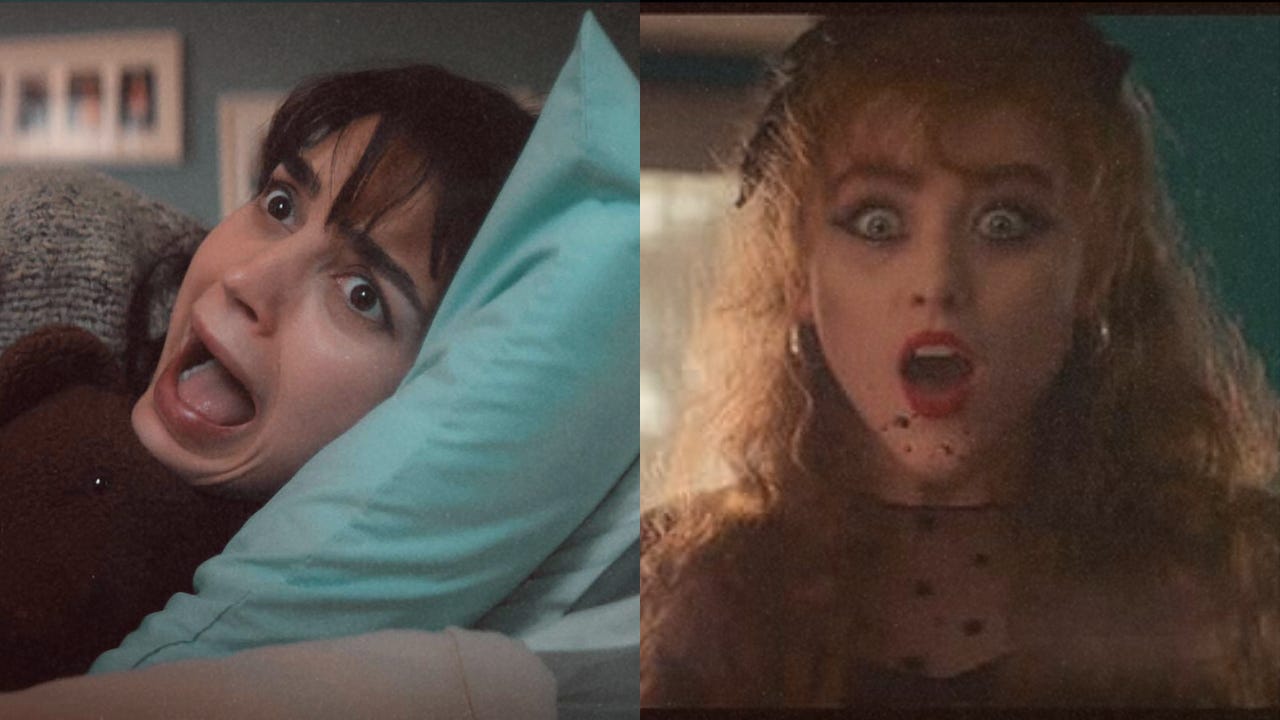
In these stories, the monster-lover finds self-actualization through her relationship with her paramour. And it all begins, as these things do, with a look.
5
If to be a woman is to be blind, then to see, after a lifetime of blindness, would be quite shocking — it would be terrifying. And terror, after all, is gendered feminine, as well.
I’ve theorized before that the “female gaze” is synonymous with the horror gaze. That to see how perverse and horrifying any object that falls into the line of sight of the male gaze becomes, is how you break the fantasy of that gaze. In other words, patriarchy’s fairytale becomes a horror story when the woman looks.
But what happens after she looks? After she recognizes her own sexual otherness in the monster? When looking liking moves?
In fact, it’s when she’s staring in horror, when she’s gazing upon the terror of her own desires, of her Otherness, of her lack, that she’s able to see for the first time. And this sight, depending on how it moves her, can either liberate or destroy her.
6
There’s something rotten in the state of heterosexuality, and only gothic romance is honest about it.
As with the other themes circling her adaptation, Fennell almost gets there. Wuthering Heights (2026) is resplendent in grotesqueries, from gelatin-encased fish and pig’s blood to oozing corpses and walls of flesh. Fennell has built an aesthetic world in which desire is synonymous with disgust. Even in Lisa Frankenstein’s candy-coated world, The Creature reeks and rots, turning his would-be bride from him in melodramatic revulsion.
The gothic, a genre created for and by women, understands the romance in abjection. For men, desiring women becomes a public spectacle. But for a woman, to want to fuck a man is a private horror. Maybe that’s why so many of women’s fantasies revolve around secret relationships. Because once it becomes public, a relationship no longer belongs to the people in it, but to the rules and regulations of the culture they exist within.
Desire is a death sentence. The body is vile. Love is a horror.
What better way to describe womanhood than this?
7
The point of the monster-lover tale is that of woman recognizing and desiring, and possibly even loving, her Otherness. For feminist critics, like Mulvey, women lack desire (and are subsequently rendered passive) because of the problem of her ultimate lack: that of the phallus. According to Linda Williams, this is something the woman and the monster share, a transgressive sexuality that challenges the phallocentric male gaze. This is made literal in Lisa Frankenstein, where the monstrous love interest is missing his member.
The above monster-lover films play out as rom-coms instead of gothic romances, with their own macabre happy endings of sorts. In Your Monster, it’s a moment of triumphant violence; in Lisa Frankenstein, it’s the two now undead lovers rejecting the society that rejected them. In a literal sense, our heroines’ endings are bittersweet: one is a murderer; the other dead. But symbolically, in embracing their monsters, they’ve come to accept themselves and the aspects of themselves polite society finds monstrous.
If the state of female desire under patriarchy is to be condemned to only ever seeing yourself through the male gaze and to be imbued with the shame of being looked at, then a female language of desire would externalize her desire so that she may do the looking, may look back at the abjection of her desire, undo the abjection, fall in love with it.
8
Then there are the shame-based monster-lovers.
At the climax of Wuthering Heights (2026), Cathy breaks the action of the film when the fingers are pried from her eyes in a moment of clarity. She sees her and Heathcliff’s shared depravity when he threatens to kill her husband as a bit of dirty talk during another boring sex scene (the longest, most tired sigh imaginable). She sees his monstrousness (and hers) and is disgusted by it (no no no!) — says it degrades her — ending their relationship and accelerating the ruin of their lives. Cathy rejects her monster, disappearing, instead, into the dollhouse, dying quietly from within her gilded cage.
In Robert Eggers’ Nosferatu (2024), Ellen is shamed for her sexuality and, in her repression, her desires transform into a rotting, vampiric force that eventually kills her. I know many viewers read Count Orlock as a metaphor for abuse instead of desire, but this distinction overlooks how abuse and sex are inextricably linked under patriarchy.
And still it remains: Death is the fate of our heroines who succumb to shame instead of self-acceptance when confronted by their monstrousness.
9
In Lisa Frankenstein and Your Monster, the protagonists embrace their monsters, dance with their monsters, fuck their monsters, all while embodying a range of emotions (confidence, anger, desire) that contrast with where they start their stories. They’re obnoxious, confrontational, horrible even. Meanwhile, Cathy and Ellen withdraw into themselves, all but mute as they wither away in feminine ennui (a sigh so big it could shake the world).
10
When you’ve only seen yourself through the eyes of a society that wishes to discipline you, you will only see yourself as in need of discipline.
But what if you could love what society tells you is wrong with you? What if you could gaze upon your shame with tenderness — with desire?
Heathcliff is Cathy’s desire. Monster is Laura’s. The Creature is Lisa’s. Count Orlock is Ellen’s.
Look at him with your own horrified gaze. Look to see, look to understand, look to love.
The monster is made from us, from under our rib. He is our very nature. Whatever our souls are made of, his and mine are the same.
this was SO GOOD !!
thank you!!! appreciate you reading!!